
Running the way it should
On a normal day the condenser outside cycles on, runs for a while, then shuts off once the house reaches the set temperature. The fan turns freely, the coil stays clean, and the unit holds the house steady without strain.
Your air conditioner is sized for a normal Montana summer day, not the stretch when the thermometer sits near triple digits and the air is bone dry. Once it's that hot outside, the unit has to run almost nonstop just to hold the house where you want it, and if it's low on refrigerant or the coil is dirty, it loses ground it can't make back. Dry heat also means the attic and walls are soaking up more heat than usual, so the house is fighting to warm up at the same time the AC is fighting to cool it. A system that kept everyone comfortable in June can fall behind in late July without anything being newly broken. Sometimes it is simple: a clogged filter or a fan that isn't moving enough air. Sometimes it's a sign the unit was never quite sized right for your house.
On a normal day the condenser outside cycles on, runs for a while, then shuts off once the house reaches the set temperature. The fan turns freely, the coil stays clean, and the unit holds the house steady without strain.

On a bad stretch the same unit runs and runs and the house still climbs a few degrees past the setting. Weeds and gravel crowd the cabinet, the coil is caked with dust, and the condenser can't shed heat fast enough to keep up.




Your air conditioner doesn't make cold air. It moves heat from inside your house to the outdoor coil, and that coil can only get rid of heat as fast as the outside air lets it. On a normal day there's enough of a gap between the air in your house and the air outside for that to happen without much strain. Once it's near 100, that gap closes, and the system has to work harder for the same result. Most units are built to drop the indoor temperature about 20 degrees below whatever it is outside, so on a 98 degree afternoon, 78 inside is about what you'll get even with everything running right. The compressor keeps running because the thermostat never reaches its setting, and a unit that never shuts off never gets a break. If the outdoor coil is dirty or the refrigerant charge is low, or if a clogged filter is choking airflow inside, that shows up worst right when the system is already working at its limit.




When your AC falls behind on one of these afternoons, you're not just dealing with a hot house. You're trying to figure out if it's something simple or something that needs a part on hand, then finding someone who actually works on these units and has time before the next hot stretch. That search usually means calling a few numbers, describing the same problem each time, and waiting to see who calls back first. Send the request here instead and it goes to one licensed contractor working in Montana, someone who sees this exact failure every summer when the heat sits near triple digits and dry air stops being enough to help the coil along. You get one call to make, one explanation to give, and someone who already knows what a condenser struggling in this heat usually needs.
Every degree the outside air climbs past 95 makes the compressor work harder to push heat out of the house. At 90 degrees it might run most of the afternoon and keep up fine. At 100, it can run flat out and still lose ground, because the coil outside has less room between the air temperature and the refrigerant temperature to dump that heat into. The system isn't broken just because it's straining. It's doing what it was built to do, against a harder job than most days ask of it.
Montana's dry air helps swamp coolers and keeps the humidity off your skin, but it does nothing for the refrigerant cycle inside a standard AC. That kind of cooling depends on evaporating water, and a central air conditioner doesn't work that way. It cools by moving heat through a sealed loop of refrigerant, and that loop only cares about the outside temperature, not how much moisture is in the air. So on a hot, dry Montana afternoon, the air feels easier to stand in, but the unit outside is working just as hard as it would in a humid state.


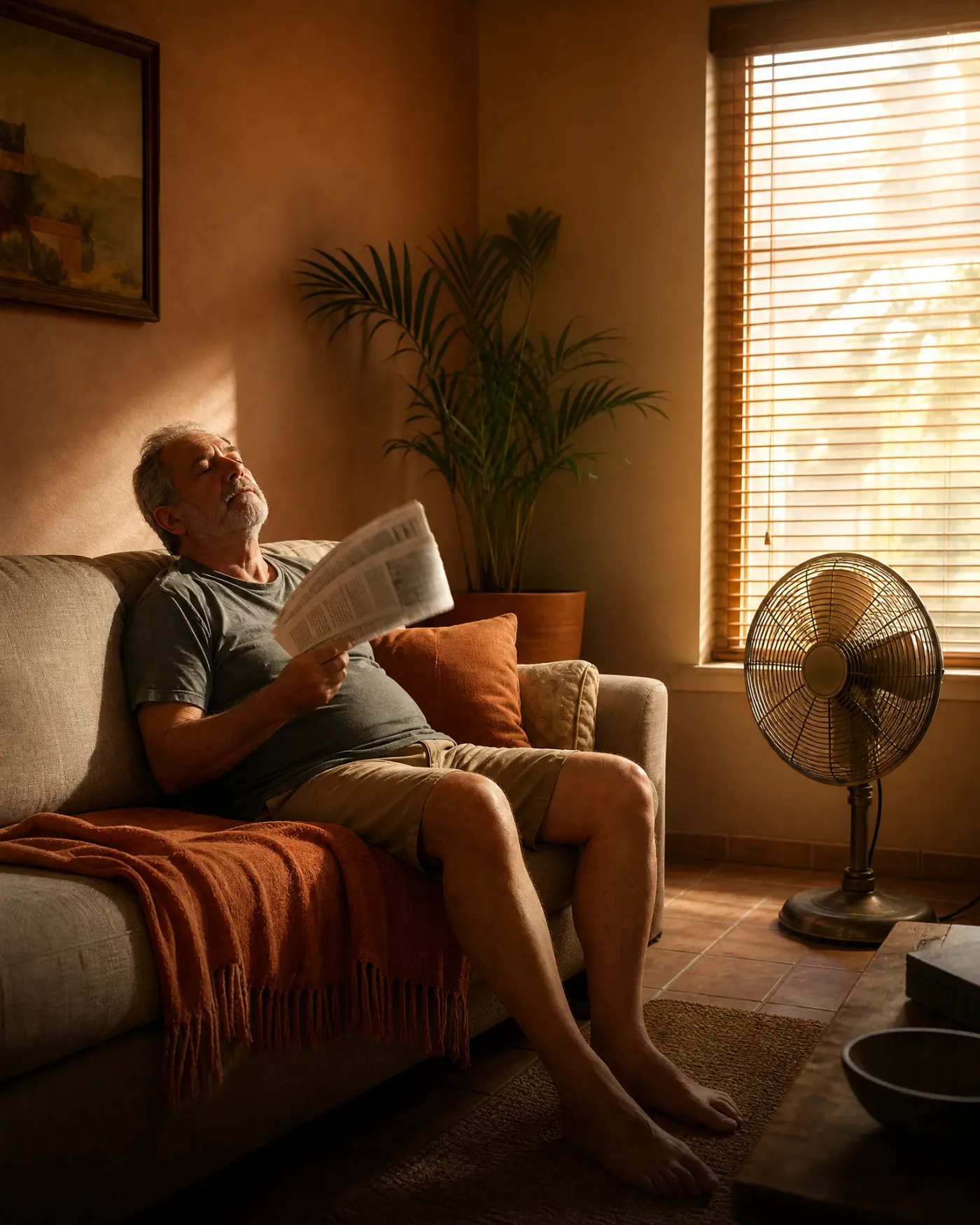
By late afternoon on a hundred-degree day, your house is still climbing, the vents are blowing air that doesn't feel much cooler than the room, and the thermostat won't move no matter how long the unit runs.
That's the heat load winning, and running the unit harder or longer won't fix a coil that's dirty or a charge that's low. It takes a contractor finding what's actually wrong and correcting it.
At 12.99 cents a kilowatt-hour, running your AC flat out on a 100-degree day doesn't cost what it would somewhere with pricier power. The strain on the unit itself is the real problem, and that's not something a higher bill fixes.
EIA-861 2025 statewide residential average
Your air conditioner is built for a normal Montana summer afternoon, and on those days it keeps up fine. The hard stretch near a hundred degrees asks more of it than it was sized for, and whether it holds depends on how much margin it has left. A clean coil and open airflow give it that margin. A dirty coil, a blocked base, or a part that's starting to fail take it away right when the heat load is highest. That's why the same unit can hold steady at 90 and lose ground at 100. It isn't necessarily broken. It may just be running without the capacity it needs on the worst days, and the only way to know which is true is to have someone look at it.
That's where a local contractor who works on these units all summer matters. They've seen what usually gives out first once the temperature climbs into the high 90s and stays there, because they're out on these calls every time it happens. You explain the problem once, to one licensed contractor, not to a handful of companies you've had to call around and compare. They come knowing roughly what to check first and what tends to be the culprit on a day like the one you're having.
Once the coil is clear, the airflow is open, and any weak part is replaced, the unit gets back the margin it lost. It can run hard on a hundred-degree afternoon and still hold the house where you set it, which is what it was supposed to do all along.





Your request stays with one local pro.
Sending the form costs nothing.