Tell us about the job
Takes about a minute. No obligation.
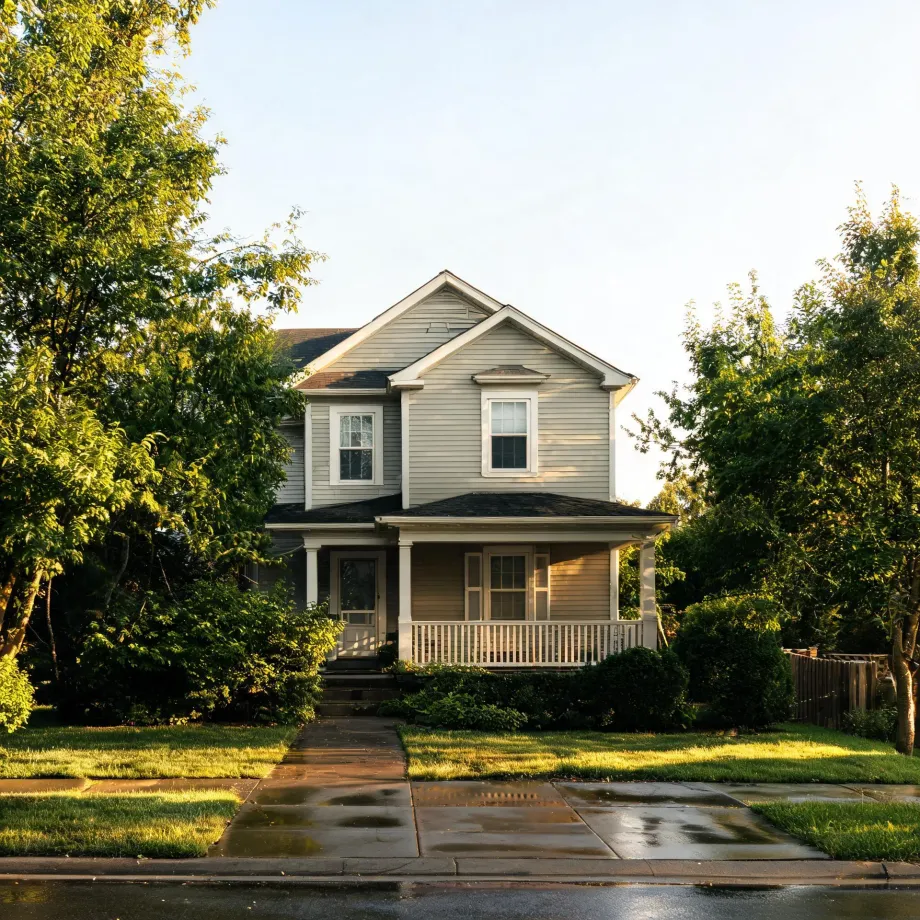
A contractor sizing and installing central AC in Glacier County has to account for a system that will almost never run. Homes in Glacier County, MT have essentially no cooling season — no month of the year is warm enough to call for it. A compressor that sits off indefinitely can develop seized components, dried seals, and refrigerant migration that show up only when the unit is finally called on. That first startup, after a long idle period, is when hidden installation faults surface too: an undersized line set, a weak contactor, a coil that was never properly charged. The installer's work has to hold against a machine that runs rarely and without warning.
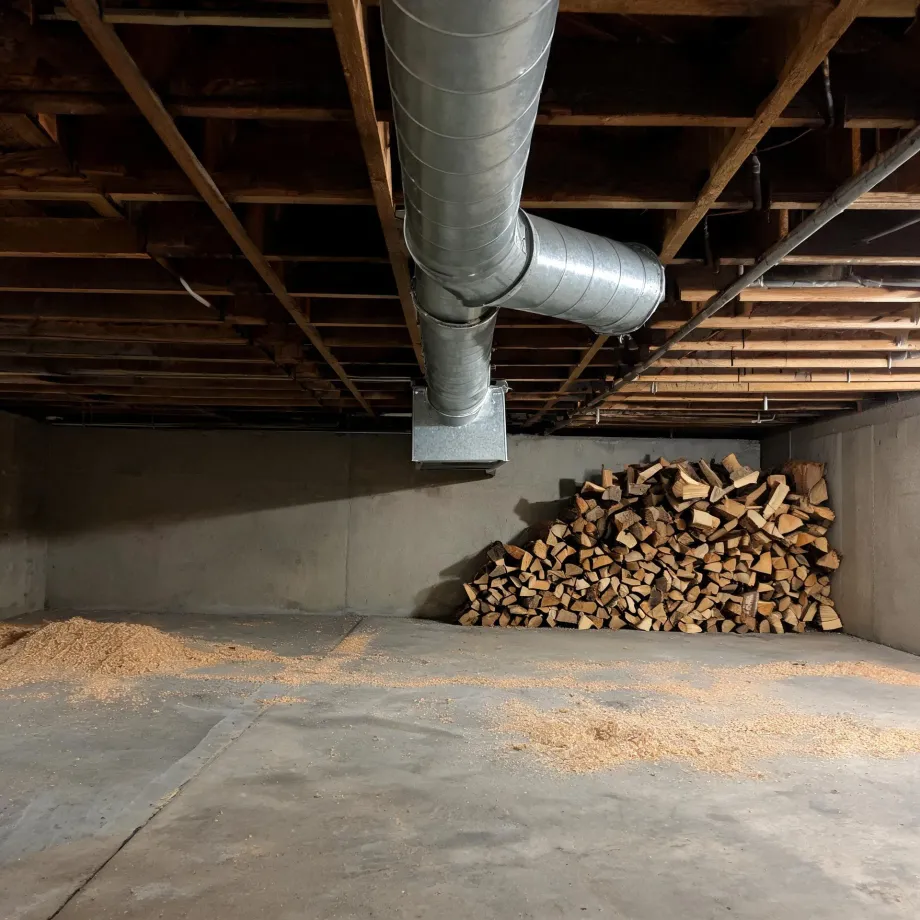
Existing ductwork is what a central AC installation turns on here, and much of it was put in for a furnace, not a cooling system. Half the homes in Glacier County, Montana were built in 1974 or earlier (2020-2024 ACS 5-year). Ductwork laid out for heat moves air differently than cooling requires: the trunk runs, the branch sizing, and the return placement all reflect what the house was built around. A contractor scoping a new system has to read what is already in the walls before anything gets quoted, because ductwork that cannot carry the airflow a new unit delivers means the equipment choice comes second.
The Central AC Equipment a Contractor Installs
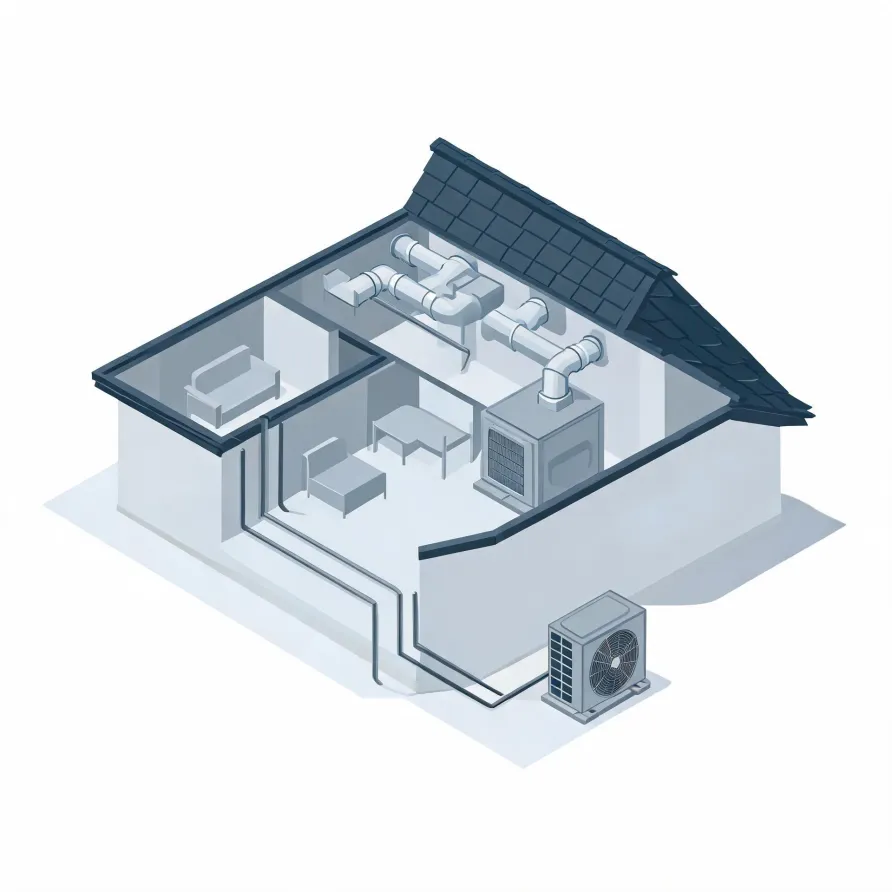
The indoor air handler sits inside the house, most often in a utility room, basement, or attic, and it is the unit that moves conditioned air through the home. Paired with it, the outdoor condenser unit sits on a concrete pad outside, where it sheds the heat pulled from inside.
A refrigerant line set runs between those two units, carrying refrigerant back and forth through insulated copper tubing. A metering device, usually mounted at the air handler, regulates how much refrigerant enters the indoor coil, and a disconnect box is mounted near the outdoor unit to give a safe shutoff point for the equipment.
The drawing shows a typical layout, and a licensed contractor determines what applies to this house specifically.
Find a contractor in Glacier CountyGlacier County, by the numbers
250 severe weather events were recorded in Glacier County, Montana between 2015 and 2024.
NOAA National Centers for Environmental Information, Storm Events Database, bulk CSV export, events 2015-01-01 through 2024-12-31.Half the homes in Glacier County, Montana were built in 1974 or earlier (2020-2024 ACS 5-year).
U.S. Census Bureau, 2020-2024 American Community Survey 5-Year EstimatesGlacier County, Montana holds 5,350 housing units (2020-2024 ACS 5-year).
U.S. Census Bureau, 2020-2024 American Community Survey 5-Year EstimatesOwners occupy 63.7% of the occupied homes in Glacier County, Montana (2020-2024 ACS 5-year).
U.S. Census Bureau, 2020-2024 American Community Survey 5-Year EstimatesRules & Standards Behind Central AC Installation in Glacier County, Montana10 sourced rules and standards
What the Installation Actually Looks Like
Split-system central air conditioners rated below 45,000 Btu/h manufactured on or after January 1, 2023 must meet a federal minimum of 13.4 SEER2.
Split-system central air conditioners rated at or above 45,000 Btu/h manufactured on or after January 1, 2023 must meet a federal minimum of 13.4 SEER2.
Split-system central air conditioners manufactured between January 1, 2015 and December 31, 2022 had to meet 13 SEER, the metric that preceded SEER2.
Single-package central air conditioners manufactured on or after January 1, 2023 must meet a federal minimum of 13.4 SEER2.
Space-constrained central air conditioners manufactured on or after January 1, 2023 must meet a federal minimum of 11.7 SEER2.
Federal efficiency standards for split-system central air conditioners and heat pumps are set on each certified combination of outdoor unit and indoor coil rather than on the outdoor unit alone.
Residential and light commercial air conditioning and heat pump systems assembled in the field, including mini-splits and unitary systems, may not be installed on or after January 1, 2025 using a refrigerant with a global warming potential above 700.
A field-assembled system whose specified components were all manufactured or imported before January 1, 2025 carries no installation compliance date under the refrigerant restrictions and may still be installed.
Licensing Rules for Glacier County, Montana
Montana’s contractor licence does not reach a casual, minor or inconsequential job whose total price for labour, materials and everything else is less than $2,500 — and the exemption is lost if the work is only part of a larger operation, or if a job is divided up to get under the figure.
Montana requires a current construction contractor licence from the Department of Labor and Industry: an individual or business may not engage in business as a construction contractor without one.
Severe Weather Events in Glacier County
Weather in Glacier County puts real demands on cooling equipment, and those demands shape what a correct installation looks like here. A system sized and specified for local conditions handles the workload that local conditions actually create.
250 severe weather events, 2016–2024. Source: NOAA National Centers for Environmental Information, Storm Events Database.