Tell us about the job
Takes about a minute. No obligation.
A contractor sizing a central AC system in Flathead County has to start by asking what the equipment will actually be asked to do here. Homes in Flathead County, MT have essentially no cooling season — no month of the year is warm enough to call for it. That changes the failure math. A compressor that breaks down has not worn out from heavy seasonal cycling, so the contractor's quote and the load calculation have to account for a system that will sit idle far more than it runs, and for the long-idle failure modes that come with it. Moisture intrusion, contactor corrosion, and refrigerant issues that go unnoticed until the first call matter more than compressor fatigue.
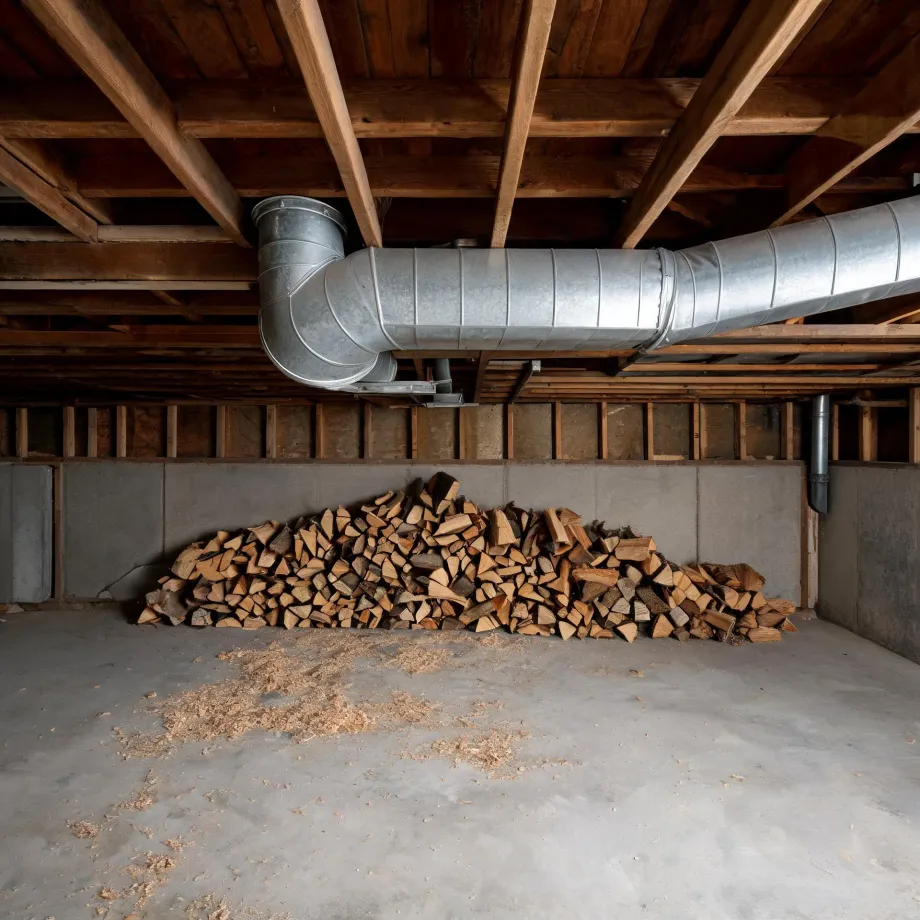
Existing ductwork is what a contractor has to price before the equipment. Half the homes in Flathead County, Montana were built in 1991 or earlier (2020-2024 ACS 5-year). A house built to that point was ducted for whatever was running then, and when a new central AC system goes in, the contractor has to determine whether those ducts move enough air, whether the runs are laid out to serve the new unit, and whether the electrical service supports the load the new equipment draws. If the ductwork falls short, that work gets priced before the outdoor unit does.
The Parts of a Central AC System and What They Do
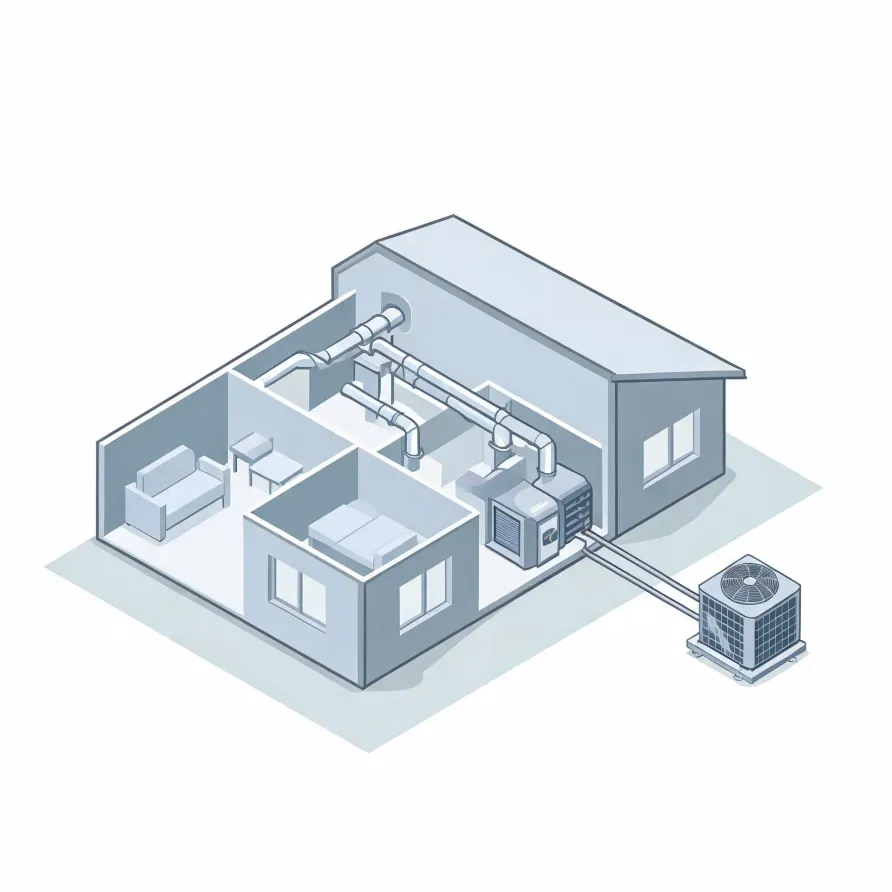
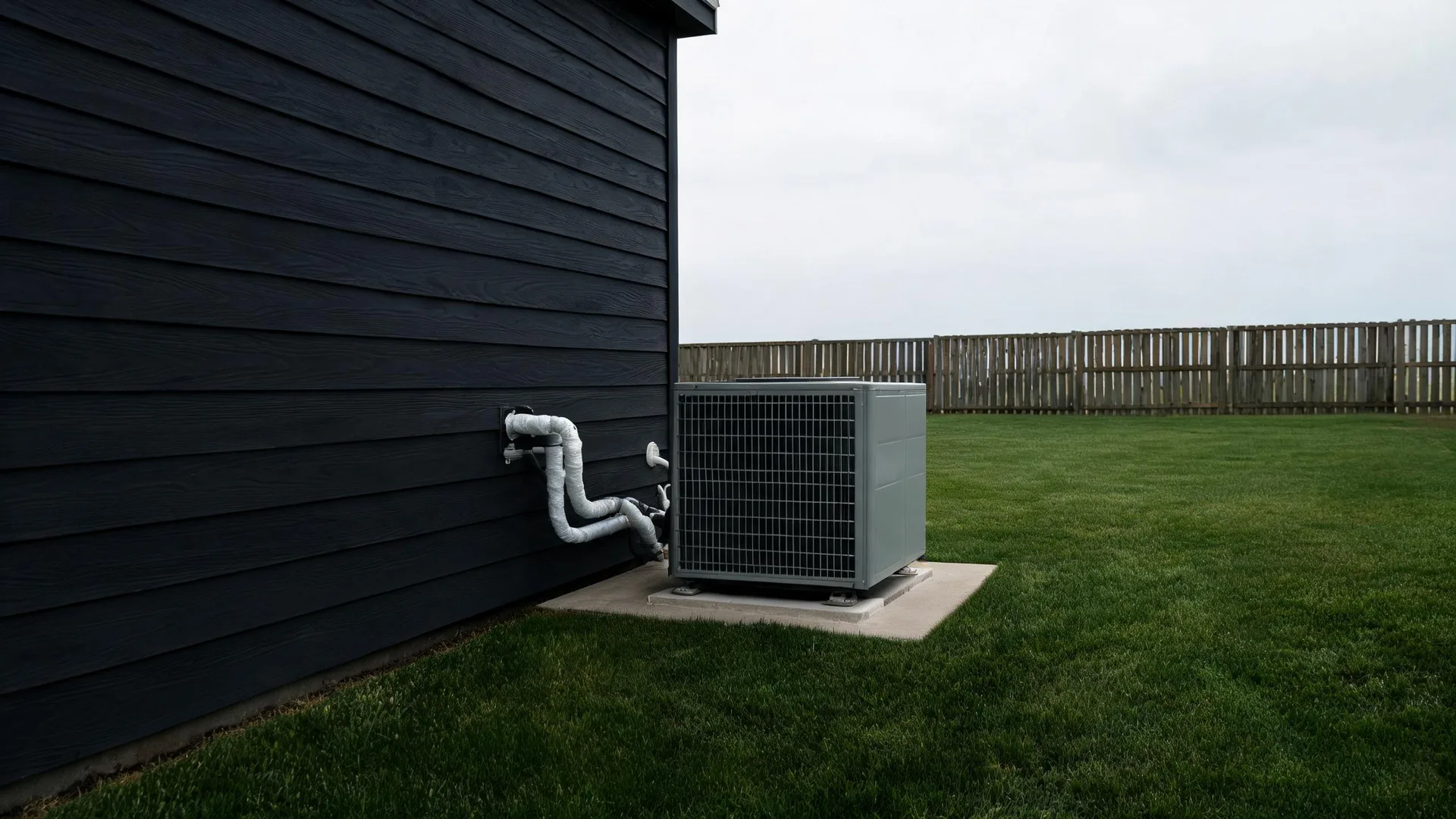
The outdoor condenser unit sits outside the house, usually on a concrete pad along a side or rear wall, and it holds the compressor and condenser coil. The indoor air handler or furnace cabinet lives inside, most often in a utility closet, basement, or attic, and it moves conditioned air through the home. Together these two units form the working core of the system.
A refrigerant line set runs between the two units, carrying refrigerant back and forth through insulated copper tubing that passes through the wall. The evaporator coil sits directly above or within the air handler, and a condensate drain line carries away the moisture the coil pulls from the air. A thermostat on an interior wall ties it all together, reading the temperature and telling the system when to run.
The drawing beside this text shows the general layout of a central AC system, and a licensed contractor determines exactly how each piece fits the setup in your house.
Find a contractor in Flathead CountyFlathead County, by the numbers
205 severe weather events were recorded in Flathead County, Montana between 2015 and 2024.
NOAA National Centers for Environmental Information, Storm Events Database, bulk CSV export, events 2015-01-01 through 2024-12-31.Half the homes in Flathead County, Montana were built in 1991 or earlier (2020-2024 ACS 5-year).
U.S. Census Bureau, 2020-2024 American Community Survey 5-Year EstimatesFlathead County, Montana holds 51,680 housing units (2020-2024 ACS 5-year).
U.S. Census Bureau, 2020-2024 American Community Survey 5-Year EstimatesOwners occupy 72.4% of the occupied homes in Flathead County, Montana (2020-2024 ACS 5-year).
U.S. Census Bureau, 2020-2024 American Community Survey 5-Year EstimatesRules & Standards Behind Central AC Installation in Flathead County, Montana10 sourced rules and standards
What the installation actually looks like
Split-system central air conditioners rated below 45,000 Btu/h manufactured on or after January 1, 2023 must meet a federal minimum of 13.4 SEER2.
Split-system central air conditioners rated at or above 45,000 Btu/h manufactured on or after January 1, 2023 must meet a federal minimum of 13.4 SEER2.
Split-system central air conditioners manufactured between January 1, 2015 and December 31, 2022 had to meet 13 SEER, the metric that preceded SEER2.
Single-package central air conditioners manufactured on or after January 1, 2023 must meet a federal minimum of 13.4 SEER2.
Space-constrained central air conditioners manufactured on or after January 1, 2023 must meet a federal minimum of 11.7 SEER2.
Federal efficiency standards for split-system central air conditioners and heat pumps are set on each certified combination of outdoor unit and indoor coil rather than on the outdoor unit alone.
Residential and light commercial air conditioning and heat pump systems assembled in the field, including mini-splits and unitary systems, may not be installed on or after January 1, 2025 using a refrigerant with a global warming potential above 700.
A field-assembled system whose specified components were all manufactured or imported before January 1, 2025 carries no installation compliance date under the refrigerant restrictions and may still be installed.
Licensing and Legal Requirements in Flathead County, Montana
Montana’s contractor licence does not reach a casual, minor or inconsequential job whose total price for labour, materials and everything else is less than $2,500 — and the exemption is lost if the work is only part of a larger operation, or if a job is divided up to get under the figure.
Montana requires a current construction contractor licence from the Department of Labor and Industry: an individual or business may not engage in business as a construction contractor without one.
Severe Weather in Flathead County
Weather events put real demand on cooling equipment: the harder the swings, the harder a system works to hold a set point. Sizing and installing central AC for Flathead County means accounting for what the local climate actually does.
205 severe weather events, 2015–2024. Source: NOAA National Centers for Environmental Information, Storm Events Database.